
Lesson 2
How the treatments work
Established science. Settled medical knowledge, curated for teaching — distinct from the platform’s own evolving research.
Every approved HER2 medicine does one of three things. Remember the receptor from Lesson 1 — a part outside the cell, and a switch inside. Two approaches attack the outside, one jams the inside, and a clever third uses the outside as a delivery address for chemotherapy. That’s the whole picture.
1 · Antibodies
Large molecules that clamp onto the outside of HER2 and stop it working.
2 · Kinase blockers
Small molecules that slip inside the cell and jam the switch.
3 · Guided missiles
Antibodies carrying a chemotherapy payload, delivered to the cancer cell.
Approach one
Antibodies — block it from outside
An antibody is a large molecule your own immune system uses to grab onto specific targets. Scientists designed antibodies that grab onto the outer part of HER2. Once attached, they get in the way: some stop HER2 from pairing up (remember dimerization from Lesson 1), and some also flag the cancer cell so the immune system attacks it. No pairing, no growth signal.
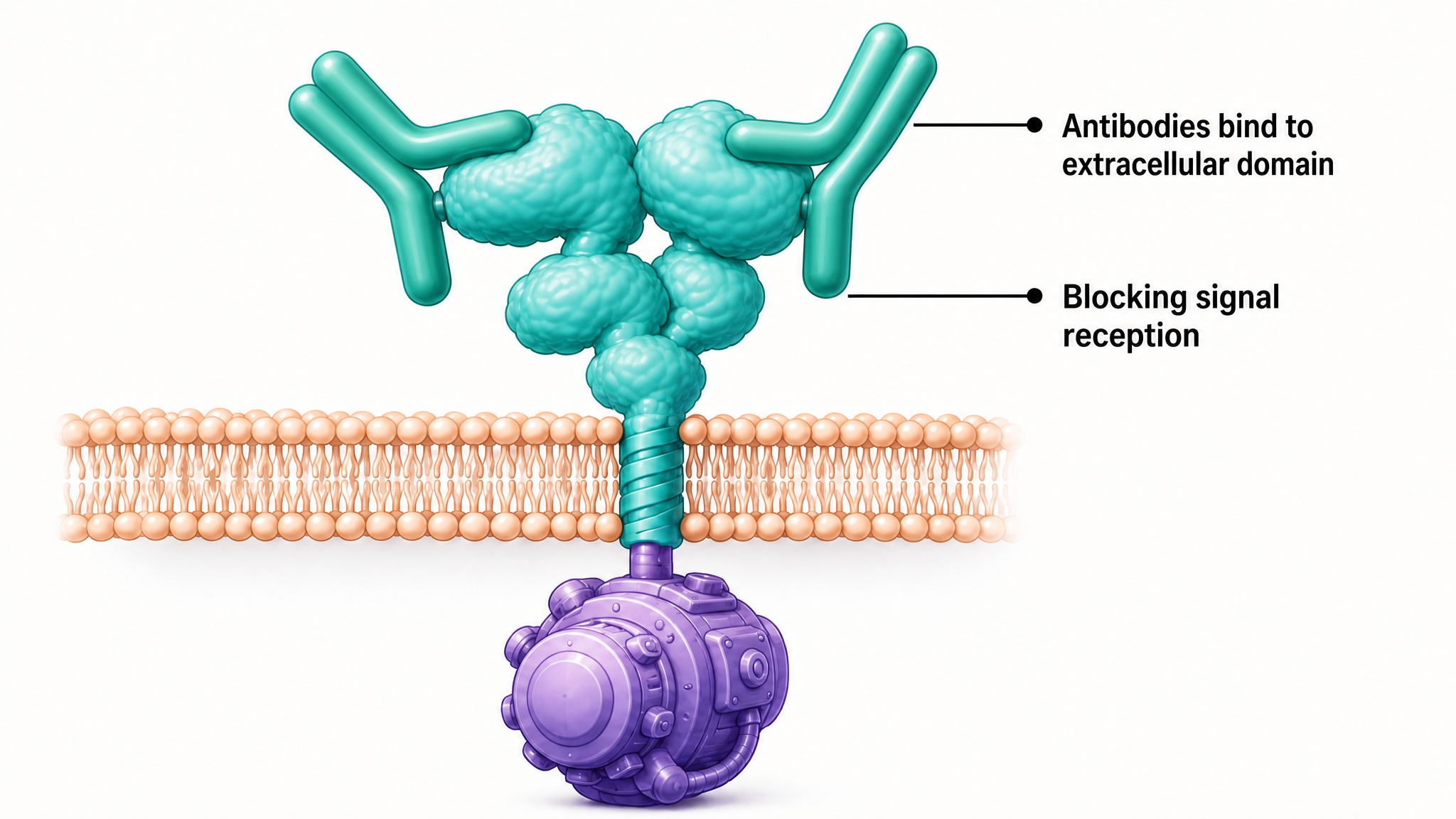
Two of the approved medicines are exactly this kind of antibody, and they grab different spots on the receptor — which is why doctors often give them together for a stronger, double block.
Approach two
Kinase blockers — jam the switch inside
The switch on the inside of HER2 is called a kinase. To fire, it needs a small fuel molecule (called ATP) to dock into a specific pocket. Kinase blockers are small enough to slip inside the cell and sit in that pocket themselves — taking the fuel’s place. With the pocket plugged, the switch can’t fire, no matter how many antennas are on the surface.
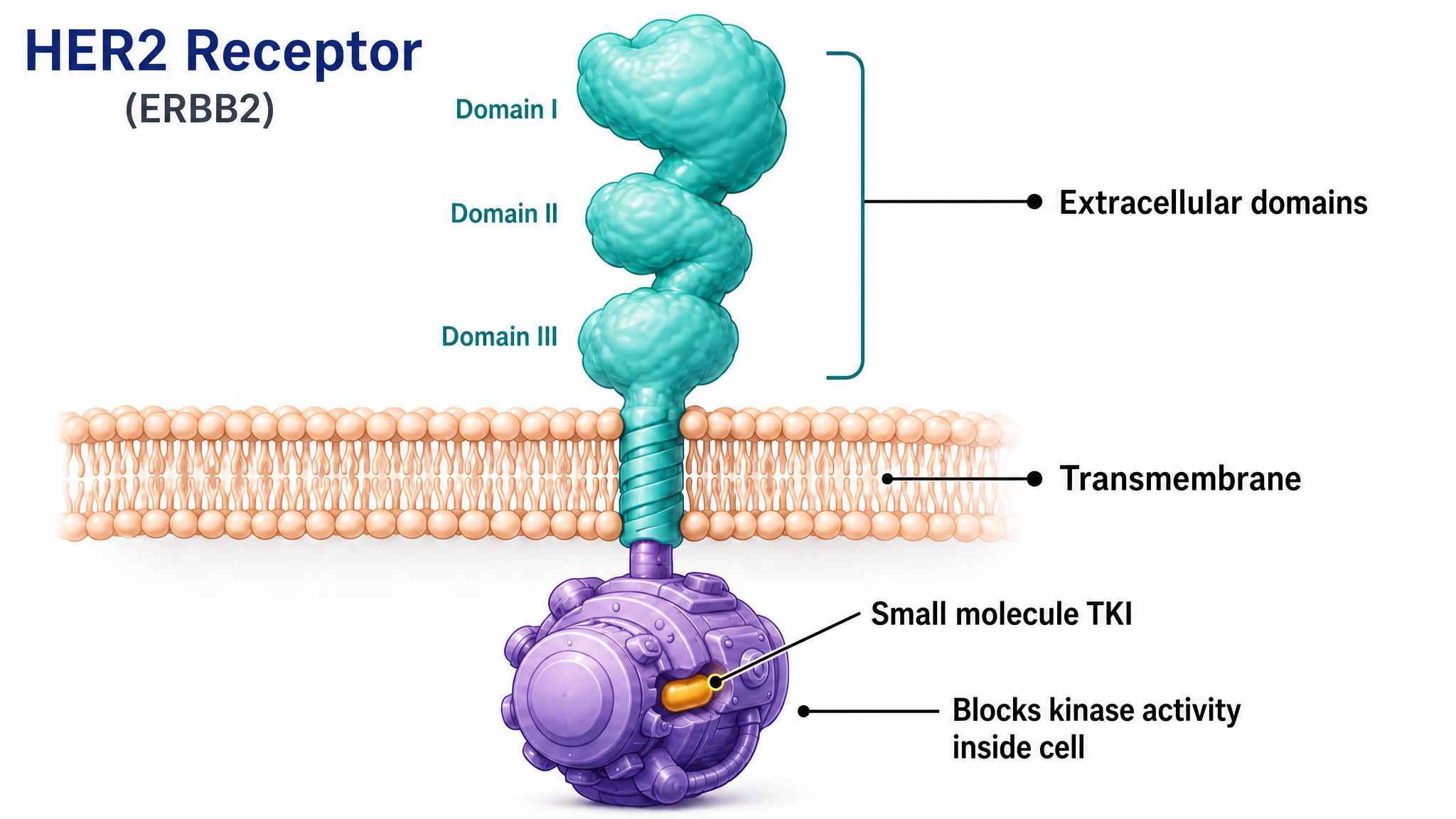
Because they’re small, these come as pills. Some are very precise about HER2; others also hit HER2’s relatives. And because they enter the cell rather than just sitting on the surface, some can reach places larger antibodies struggle to — which matters for cancer that has spread to the brain.
Approach three
Guided missiles — deliver chemo to the target
This is the newest idea, and a genuinely elegant one. Start with an antibody that finds HER2 (approach one). Now chemically tie a powerful chemotherapy drug to it. The antibody acts as a homing device: it travels the body, latches onto HER2-covered cancer cells, gets pulled inside, and only then releases its toxic payload — right where it’s needed. Doctors call these antibody-drug conjugates.
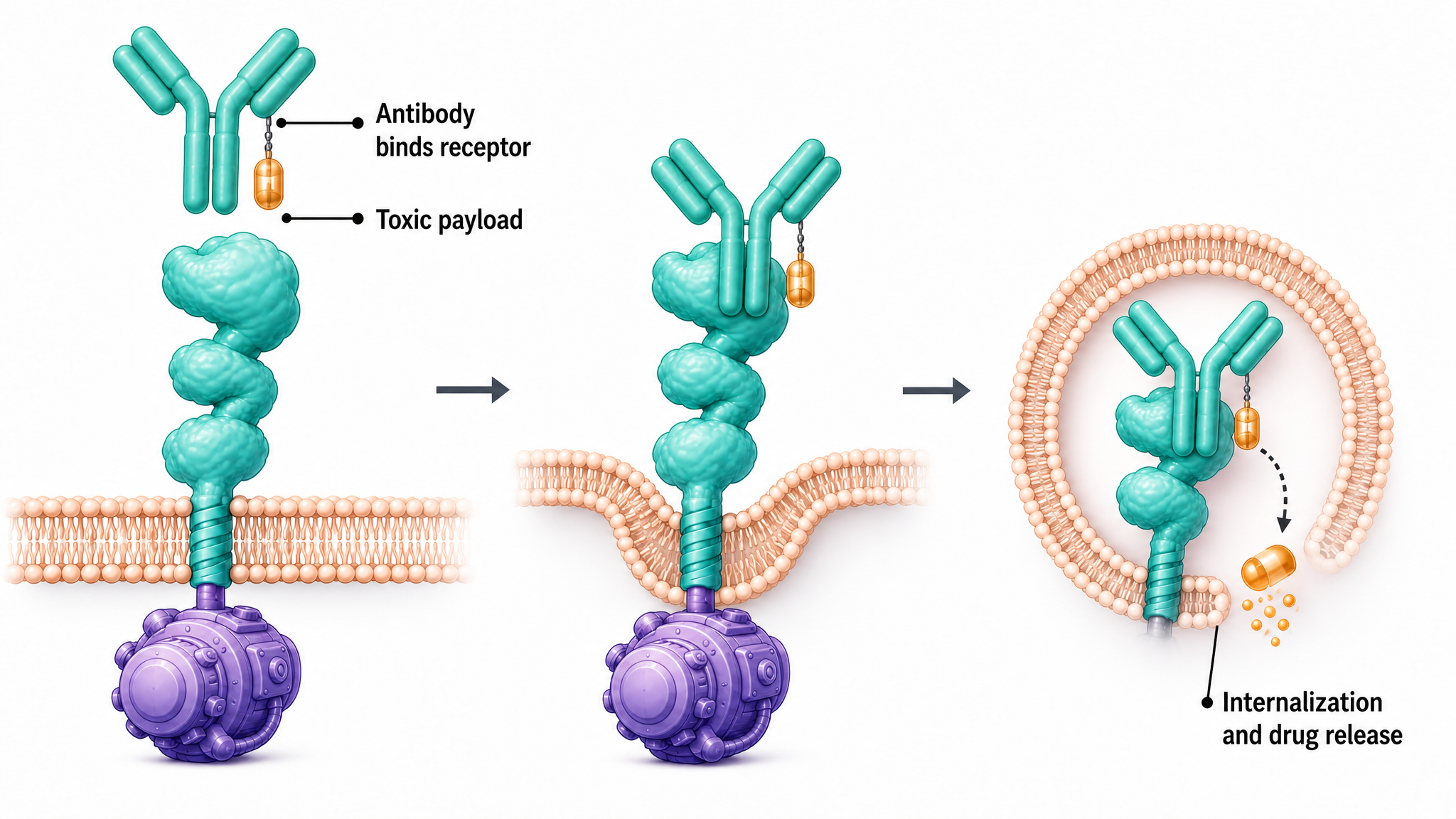
The advantage is aim. Ordinary chemotherapy floods the whole body; this delivers a concentrated dose mostly to cells wearing the HER2 marker, sparing more of the healthy ones. Some newer versions even harm neighbouring cancer cells as the payload leaks out — a bonus called the bystander effect.
The whole idea in one line
Block the outside, jam the inside, or use the outside as a delivery address. Next, meet the seven real medicines that do exactly these three things.
Beyond the settled science: the platform’s frontier
These three approaches are proven and in daily use. What’s still being worked out — why a cancer sometimes stops responding, and which combination to reach for next — is active research. The platform tracks those unresolved questions separately from this settled guide.